...A favorite quote: “Some artists depict the sun as a yellow spot, while others transform a yellow spot into the sun.” This saying is said to have come from the pen of Pablo Picasso.
A Phenomenon of Superlatives
Eccentric, bold, temperamental, and distinctive—for many, he is the symbol and embodiment of 20th-century painting. His name has long since become synonymous with a talented artist. And his figure is constantly surrounded by superlatives: the most famous, the most original, the most recognizable, and the most influential artist in history.
Genius: The Verdict of Statistics
- One of the most expensive painting in the world (among those ever sold) is “Women of Algiers” by Pablo Picasso. Christie’s auction. Around 180 million dollars.
- The most prolific artist in the world. This fact, by the way, is recorded in the Guinness Book of World Records: 13,500 paintings, 100,000 prints, 34,000 book illustrations, hundreds of sculptures and ceramic works. In total—around 150,000 works of art!
- And since we are on the subject of superlatives, he is also the most “stolen” (pardon the neologism) artist in the world. Hundreds of his canvases remain missing. In a way, this too is a compliment!
“Inspiration exists, but it must find us at work”—Pablo Picasso.
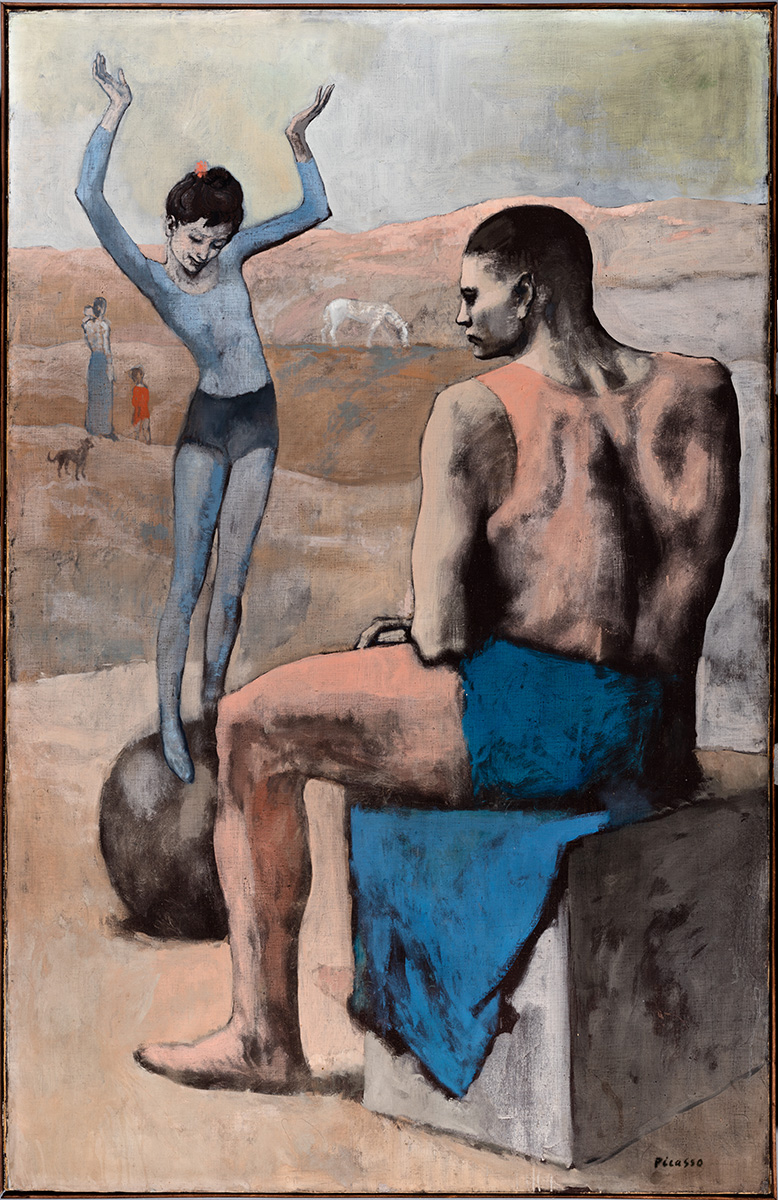
...And so, “Girl on a Ball”—Pablo Picasso, 1905.
A World Without Intrigue and Vanity
Tenderness, a sense of airiness, rose, sky-blue, and pearl tones—this is what immediately “embraces” the viewer, inviting them into an atmosphere of special coziness, the natural order of things.
In this world, no one is rushing anywhere.
In this world, intrigue does not exist.
In this world, no one struggles or plays with anyone else.
Everything and everyone is in their place, never seeking to claim another’s.
There is no guile or play-acting here, even though it is a circus.
And perhaps it is this very sincerity that is the “precious prism” through which we gaze at this acclaimed masterpiece. As well as the perfect harmony, coherence, and balance of a world where one cannot exist without the other.
The contrast between instability and stasis. A play of fragility and strength. A balance of youth and maturity, of hope and doom. A synthesis of Pablo Picasso’s “Blue” period—with its melancholy, sorrow, and grief—and his “Rose” period, light and optimistic.
Sedes Fortunae rotunda, Sedes Virtutis quadrata
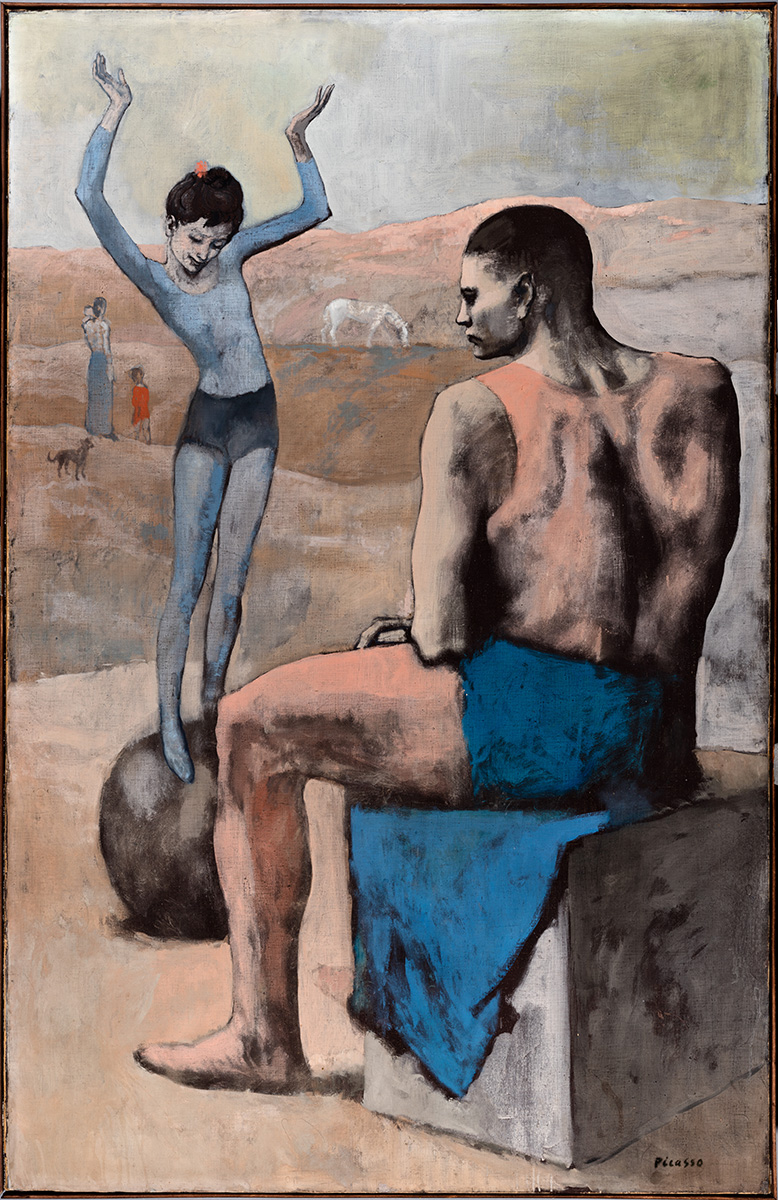
Critics, art historians, art experts… their purpose, their mission is not only to analyze masterpieces from an artistic perspective, but also to imbue them with meaning that may not even have been known to the brilliant creators of these works. One of the interpretations of Pablo Picasso’s “Girl on a Ball” is the idea that the sphere is the pedestal of Fortuna, the goddess of fate. A symbol of the instability, the elusiveness of human happiness. The cube is the pedestal of prowess.
Scholars cite the Latin maxim: “Sedes Fortunae rotunda, Sedes Virtutis quadrata” (the seat of Fortune is round, and the seat of Virtue is square).
Pablo Picasso, “Girl on a Ball”
Claude Debussy, “The Girl with the Flaxen Hair”
The composer writes: “Music is not an expression of feelings, it is the feelings themselves.”
And we hear, we feel the infinite shades, nuances, and halftones from which this “watercolor” beauty seems to be woven.
And we realize that the perfection of this image lies not in portrait likeness, but precisely in the elusiveness of contours, in crystalline clarity, in the fragrance of the air, and in the fragile delicacy of its sonic atmosphere.
“Music is the silence between the notes.” — Claude Debussy.