POP-ART?
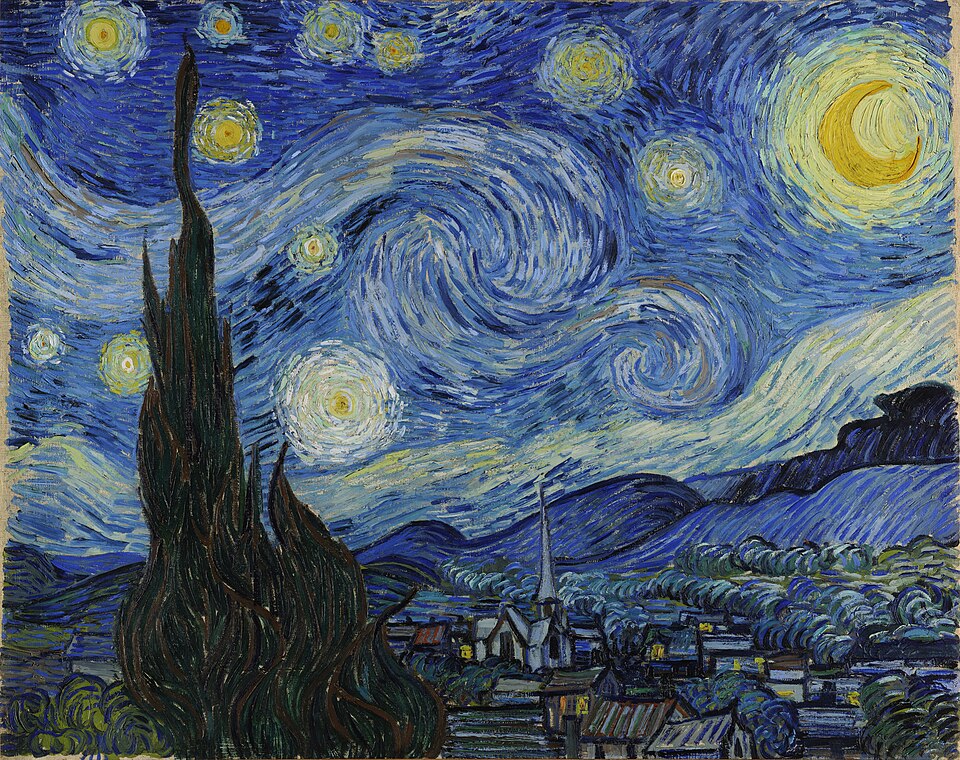
Vincent van Gogh "The Starry night" – is one of the most iconic works in the entire history of human painting! It is often described as Van Gogh’s magnum opus.
It’s a kind of "pop art" — not as an art movement, but in terms of the role this painting plays in the collective consciousness. In other words, it is a true "hit".
In the context of art discussions, the word "hit" may sound somewhat unexpected or even provocative. However, this is only due to a modern misconception. Today, we mistakenly perceive this word as a symbol of something light or even primitive. But in English, the word "hit" fundamentally means "success" or "triumph".
And this work is successful, beyond measure!
It is recognized worldwide. Collectors are willing to pay tens of millions of dollars for this canvas, yet it takes pride of place in one of the world’s most famous museums — The Museum of Modern Art in New York.Admittedly, at the time, the artist himself was rather reserved, even cold, toward this work. He somewhat dismissively referred to it as a "night study", failing to grant it the "paternal" attention and warmth he gave to others.
WHAT MAKES IT A MASTERPIECE?
And yet, it is a masterpiece! As for why — we already know the answer: everyone will find something of their own within this canvas.
Some will be struck by the story behind the painting. Van Gogh is losing his mind, tormented and torn apart by contradictions; for the artist, The Starry Night is a form of art therapy—a medicine for a wounded psyche, for a scarred soul. As we gaze at the work, we find ourselves searching for an answer to the eternal question: is genius a sign of mental health, or is it a flaw, a defect, a deviation?..
Others will be captivated by the religious undertones studied by art historians. They point to the artist's own words: "I have a terrible need — shall I say the word? — for religion. Then I go out at night to paint the stars." They also quote the Book of Genesis: "I have dreamed another dream; and behold, the sun and the moon and the eleven stars made obeisance to me." Eleven stars! And what of those "halos" glowing around the stars and the moon?..
Some will be struck by the perfection of the composition. Let’s take a closer look!
The radiance is the first thing that overwhelms the viewer. The crescent moon on the right and Venus on the left. They say that in the spring of 1889 in Provence—the exact time the painting was created—Venus did indeed shine with exceptional brilliance!
Furthermore, the forest and mountains crash in mighty waves upon the small town, which hides—tiny and inconspicuous—within its own shadow. This sense of the element's grandeur breeds a feeling of dramatic tension!
...And then, the cypress. The sole witness to the spectacle unfolding in the heavens. Its dark silhouette, resembling a Gothic cathedral, intrigues the viewer and perfectly balances earth and sky, the real image and the symbolic one, simple everyday life and infinity...BEYOND THE ORDINARY
Amazing, incomprehensible, and yet! —
Somehow, in his imagination, Van Gogh unites the grand mysteries of light and fluid motion. Through his pigments, he embodies one of the most complex and still elusive scientific concepts — the concept of turbulence.
The artist perceives, feels, and recreates the most mysterious concept that nature has ever revealed to humanity!
- Look at these vortices. And then — smaller ones, and smaller still…
- Scientists are studying them.
- They are being calculated using Fibonacci numbers.
- They are being observed through cosmic giants, such as the Hubble Space Telescope.
And they are the pulsation of the universe, something beyond the reach of scientific thought! Accessible only to the inspiration of a genius.
Vincent van Gogh "The Starry Night"
As one art critic once wrote: "It is easy to guide a brush and paint grass and plants with enough realism to satisfy the eye. Anyone can achieve this after a few years of practice. But to depict the mysteries of creation amidst those grasses and plants, to find the manifestation of the eternal and the Divine in what seems smallest — that is the true purpose of the artist"!
Perhaps this is precisely what the Romantic era composer Robert Schumann meant when reflecting on the figure of Johann Sebastian Bach. Attempting to convey the full majesty and scale of his genius through words, Schumann wrote: